
02/2026
The Architecture of Gesture and Material
Design made in Italy: a story spanning generations
Every everyday gesture has its own architecture. The line of a lever, the section of a spout, the proportion between solids and voids influence the perception of space. The tap enters the project as an element that dialogues with surfaces, volumes and light, contributing to the overall balance of the environment. Design made in Italy develops through this formal attention, building over time a continuity between design heritage and innovation.
The method: collaboration as a foundation
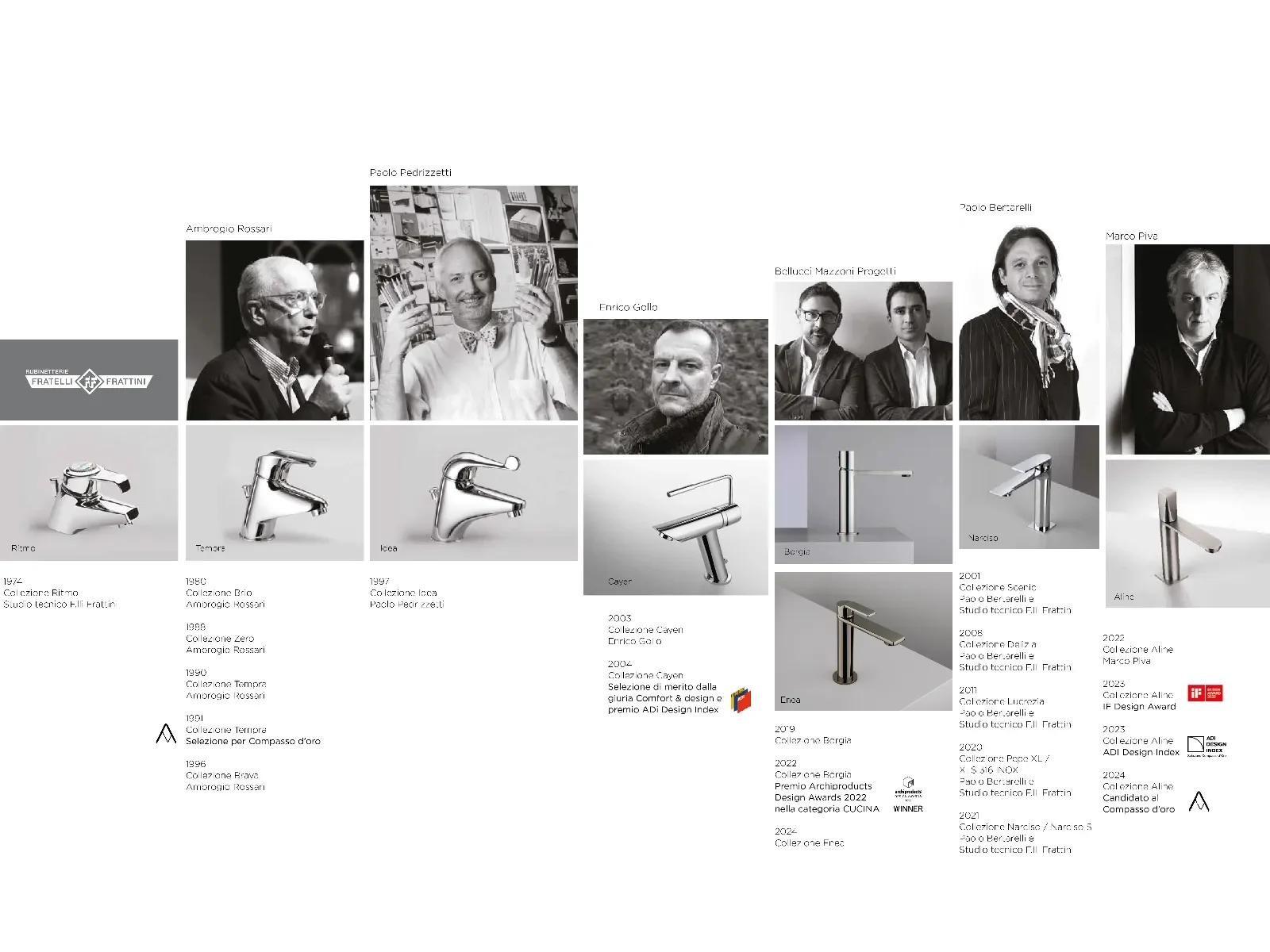
Since the 1970s, the design path has been based on dialogue with Italian architects and designers. Ritmo marks the beginning of a research journey that finds its first definition with Ambrogio Rossari: Zero, Tempra and Brava introduce an essential and structured language, capable of giving order and recognisability to form.
Collaboration becomes an integral part of the method. Each project fits into a shared vision, where design culture and manufacturing expertise proceed in balance, fostering a coherent and progressive identity.
The evolution of the language
Over the years, research expands and the sign becomes lighter. With Idea by Paolo Pedrizzetti and later with Tolomeo, Delizia and Lucrezia by Paolo Bertarelli, proportions gain greater lightness and visual balance takes centre stage. Cayen, designed by Enrico Gollo, introduces a synthesis between dynamism and geometric rigour.
In more recent years, material research has opened a new evolutionary phase. Alongside brass, the historic material of tapware, stainless steel establishes itself as a contemporary design choice, appreciated for formal rigour, resistance and aesthetic coherence. It is in this context that Borgia was created, the first 316L stainless steel series designed by Bellucci and Mazzoni Progetti: a collection that consolidates an authoritative presence in space and introduces an essential language linked to the purity of the material. Pepe XL and XLS continue in this direction, expanding application possibilities in contemporary and contract settings and enhancing the qualities of steel in high-intensity use contexts.
In parallel, brass continues to express its central role in design through collections capable of interpreting formal and chromatic versatility. Narciso and Narciso S, designed by Paolo Bertarelli, represent this evolution: made of brass and offered in eleven finishes, they expand compositional possibilities, offering designers broad expressive freedom. The multiplicity of surfaces dialogues with different contexts, maintaining coherence of line and proportion.
With Aline, designed by Marco Piva, the line reaches a formal maturity recognised internationally. Enea continues this trajectory with a measured and transversal geometry. In 2025, Don Chisciotte by Bellucci and Mazzoni Progetti introduces a reinterpretation of classical language in a contemporary key, expanding the dialogue between memory and innovation.
Awards in tapware design: Compasso d’Oro, ADI, iF and Archiproducts Design Award
In Italian design, recognition represents an objective measure of design quality. The selection for the Compasso d’Oro for Tempra in the 1990s marks a significant milestone in the company’s journey.
The presence in the ADI Design Index for Cayen and, more recently, for Aline confirms the consistency of formal research. With Aline also come the iF Design Award and the nomination for the Compasso d’Oro, consolidating a position on the international stage.
This path is further enriched by the Archiproducts Design Award 2024 assigned to the Borgia kitchen sink, designed by Bellucci and Mazzoni Progetti, expanding international recognition of formal and material research.
Awards express the solidity of a method that integrates aesthetics, functionality and long-term durability.
From method to result
From the structured lever of the first collections to contemporary essential geometries, stylistic evolution reflects transformations in living. Lines become more refined, surfaces dialogue with increasingly clean architectures, materials expand with the introduction of 316 stainless steel.
Each collection takes shape through the work of the in-house technical department, which supports the project in all its phases and turns every creative vision into reality. Engineering expertise translates the idea into product, ensuring execution precision, reliability and constructive coherence.
The result is a layered identity, built through collaborations, generations and different languages. A vision that combines design culture and production expertise, ensuring continuity and coherence over time. A design made in Italy that finds its measure in shared design and its solidity in construction quality.